



















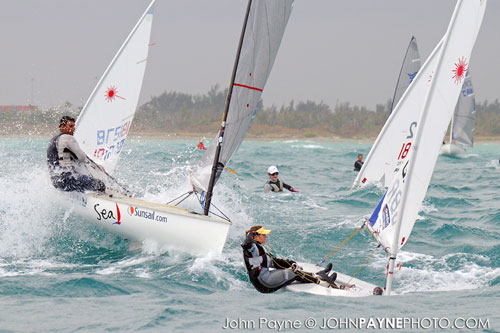
IMPROVING THE OLYMPIC PROGRAM
Following the 2012 Olympic Games, the U.S. sailing program assembled an independent panel to conduct a comprehensive review of Olympic sailing in the country and to recommend changes going forward. One of the findings was in how the U.S. spent high sums of money sending their sailors to Europe to become competitive, and recommended that domestic training needed to become a strength, and that more events were needed in the U.S. to bring the whole class/program up to speed.
To support this paradigm shift, Tom Lihan has already gotten the ball rolling. Tom knows about elite racing, himself a three-time college All-American and past Finn champion and Olympic campaigner. Tom more recently watched his daughter Sarah competing at the 2012 Olympics, and was convinced that his Lauderdale Yacht Club (Fort Lauderdale, FL) could be part of the solution.
Lauderdale Yacht Club was already the annual host to the Finn and Women’s Laser Radial Midwinter Championship in early February, but in 2013 the event is being expanded. Now called the Lauderdale Olympic Classes Regatta (Feb. 8-10), the event will be open to all Olympic events (and 29er), and will follow the ISAF Sailing World Cup event in Miami (Jan. 28-Feb. 2).
Here Tom explains their initiative:
----------------------------------------------------------------------
* What prompted the move to expand the LYC event?
TOM LIHAN: I attended the Olympic Games this past summer and watched almost every race. Without rehashing the performance of the U.S. team, it was apparent how other countries have more developed Olympic level feeder systems.
LYC has resources and a venue to add value across the Olympic classes spectrum, and we thought the best way to help was to supplement the Rolex Miami OCR event and offer support for the U.S. teams training for the quad. Our event is designed to dovetail after Miami so teams can get "double exposure" for the minimum time. Foreign teams are more likely to do both, and with nationality teams and coaches, all resources can double up.
* The 2012 Rolex Miami OCR hosted 354 entrants from 41 countries. How big can the LYC event get?
TOM LIHAN: We can host full fleets of all Olympic dinghies at our club. The membership is aware of the sacrifices that must be made and have embraced the concept of our club' involvement. Two circles in the ocean will ultimately be the logistic solution.
* Compared to Biscayne Bay in Miami, how will the sailing venue at Lauderdale Olympic Classes Regatta differ?
TOM LIHAN: Biscayne Bay is an enclosed, shallow bay with limited "fetch" and oscillating or geographic shifts. It is awesome for big fleet events and easy, safe RC work in any conditions. Sailing out from multiple clubs and venues offers an ideal training opportunity. LYC's venue is the open Atlantic Ocean.
The LYC course has a long fetch, big waves, zero geographic influence, reliable pressure, and potentially epic racing conditions with 15-foot breaking waves on our reef systems are possible. There have been days when I was barely able to exit the inlet in my 59-foot sport fishing boat, but our team has the talent to drop marks in up to 200-feet of water. Speed testing is more reliable and downwind technique in the Finn, Laser and other dinghies is rewarded and developed.
LYC member and past Laser World Champion Peter Commette always said that if you can get comfortable in the big breeze easterly in Lauderdale, you will be relaxed in anything else the planet has to offer.